Contents
Introduction: What does “ready for international expansion” actually mean?
Growing sales at home, enquiries from overseas retailers or orders from customers abroad can put international expansion on a brand’s agenda. These signals offer a reason to explore how the brand’s strengths could translate into a different competitive environment.
Pursuing that opportunity requires resources before the outcome is certain. Additional stock ties up cash. Products and packaging may need changes. Someone has to coordinate the launch and manage the ongoing business, while the existing operation continues to need attention.
Being ready for international expansion does not mean having every answer before you begin. A brand can be ready to assess a new market while still needing to resolve important questions before launching. Market research and financial planning help establish whether the opportunity is worth pursuing and what it would require. Preparing for launch then means securing funding, confirming reliable supply and assigning clear responsibility for the ongoing operation.
The following seven questions will help you assess your starting point, identify what needs further investigation and recognise which constraints should be addressed before you commit more resources.
01 – Is your home-market business strong enough to support expansion?
International expansion adds complexity before it adds scale. A new market requires management attention, working capital, inventory and operational capacity, often months before it makes a meaningful contribution to the business. The first question is therefore not how attractive the target market looks, but whether the existing business is strong enough to support the expansion.
That does not mean your home-market business needs to be perfect. But you should have a reasonably clear understanding of what already works. Which products consistently generate demand? Who are your core customers? What drives conversion and repeat purchases? And, importantly, what do your margins actually look like after advertising, fulfilment, returns and other variable costs?
This becomes especially important when deciding which parts of the existing model can realistically be transferred abroad. A product that performs exceptionally well at home is usually a stronger starting point than one whose demand is still uncertain. Likewise, a company that understands its unit economics can evaluate the additional costs of a new market far more reliably than one that is still trying to determine whether its existing sales are truly profitable.
Operational stability matters just as much. Expansion should not depend on the founders or management team personally solving every problem in the core business. If entering another market means that the existing operation starts suffering because key people are suddenly unavailable, the company may be creating one opportunity at the expense of another.
Before committing significant capital to expansion, you should therefore be able to answer questions such as:
- Which products have demonstrated reliable demand?
- Do we understand our margins and key cost drivers?
- Do we know why customers choose our products?
- Can our existing operation continue to perform while management attention is divided?
- Do we have the financial and operational capacity to support another market?
If several of these questions are difficult to answer, that does not automatically mean international expansion is off the table.
It may simply mean the business is ready to start assessing new markets, but not yet ready to launch in one.
02 – Why this market and why now?
A large market is not automatically the right market for your brand. The more relevant question is whether there is a realistic and economically attractive opportunity for your specific products, positioning and price point.
Start by examining what supports your interest. Search activity, sales of comparable products, retailer enquiries and existing orders from abroad can indicate demand worth investigating. Look at who those customers are, what they value and the prices they actually pay. This helps establish whether your existing offer has a plausible audience or would require substantial changes to appeal to local buyers.
Competition needs similar scrutiny. Established brands, high customer acquisition costs and aggressive pricing can make entry difficult even when demand is strong. At the same time, strong competition can demonstrate that customers already spend money in the category. Your assessment should explain how you could earn their business: through a product benefit, format or positioning that matters to a defined customer group.
Timing should also have a concrete business reason. Increasing demand, changes in customer behaviour or existing international interest could justify beginning preparation now. Your own circumstances matter too: available production capacity, funding and management attention may make an opportunity more realistic to pursue. Consider the time needed to prepare and whether the conditions supporting your decision are likely to remain relevant when you can launch.
Comparing credible alternatives helps establish why this particular market deserves priority. Separate assumptions supported by evidence from those that still need investigation. Actively look for findings that could challenge your preferred option, such as weaker demand, lower achievable prices or higher acquisition costs than expected. Decide in advance which findings would lead you to change the plan.
A good market assessment must remain open to different outcomes: proceed with preparation, adapt the entry strategy, or conclude that another market or another point in time offers a better use of capital.
03 – Can your products compete at a profitable price?
A product that sells profitably at home may have very different economics abroad. Your pricing needs to reflect what customers will realistically pay and the full cost of reaching and serving them.
Start by comparing similar products in your intended sales channels. Account for pack sizes, quality, positioning and the discounts customers commonly receive. If your calculation depends on a premium price, identify the benefit that would justify it to buyers who may not yet know your brand.
Then calculate what remains from each sale. Estimate revenue after discounts and refunds, excluding any VAT or sales tax collected. Include product and packaging costs, freight, applicable duties, fulfilment, marketplace or payment fees, return handling, advertising and any sales-based partner fees. This shows the contribution available to cover fixed operating costs and, eventually, generate profit.
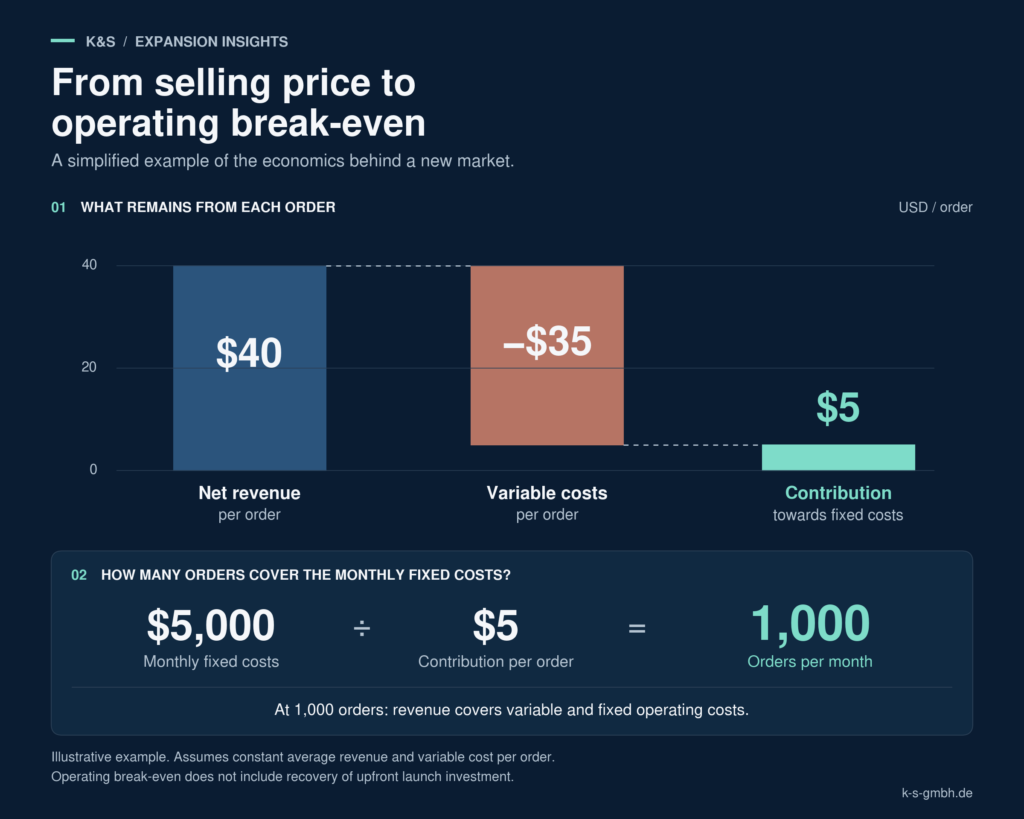
A financial model connects these economics with expected sales volumes. In a simplified example, $40 in net revenue per order and $35 in variable costs leave a $5 contribution. With monthly fixed operating costs of $5,000, the business would need 1,000 orders to reach operating break-even, assuming prices and costs per order remain unchanged. You then need to assess whether that volume is realistically achievable.
For an Amazon launch, Amazon’s fee and fulfilment cost estimates provide a starting point for channel costs. Include the remaining costs of your operation to build a complete financial model.
Test how the calculation changes if selling prices are lower, advertising costs are higher or returns are more frequent than expected. Initial launch economics may also be weaker than those of an established operation. The model should show what must improve to reach profitability and what supports those assumptions.
Our preparation of Nutri+’s U.S. market entry illustrates this challenge. The brand’s commitment to affordable vegan nutrition had to be assessed against smaller initial export volumes and additional logistics, fulfilment and advertising costs. We examined product selection, pricing and positioning alongside financial scenarios to understand how the offer could remain competitive while preserving the brand’s values.
If the business only works under optimistic conditions, revisit the product selection, pack size, pricing or channel strategy before committing. The aim is to establish a credible path to profitability and understand how sensitive it is to changes in your assumptions.
04 – Can you finance the launch and what comes after it?
A credible path to profitability needs sufficient funding to reach it. Your budget should cover preparation, the initial launch and the period during which the new business still depends on additional cash.
Start by mapping when money needs to leave the business. Product adaptations, specialist reviews, channel setup, initial inventory and transport may require payment before the first sale. After launch, marketing, fulfilment, ongoing operations and replenishment create further commitments. Sales receipts can finance part of this spending, but their timing and scale need to be reflected realistically in the plan.
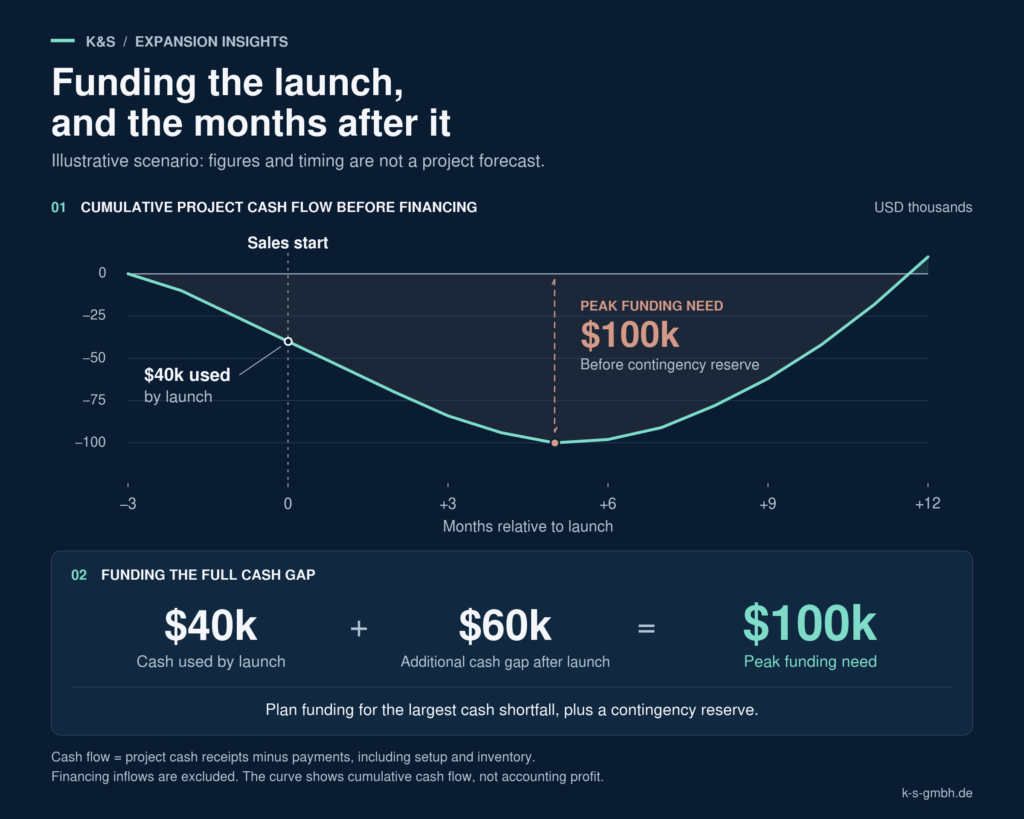
Inventory deserves particular attention. You may need to place and partly pay for a second production run while cash is still tied up in the first shipment. Supplier payment terms, production lead times and the timing of sales proceeds all affect this gap. Even a profitable operation can require additional funding as it grows.
A monthly cash-flow forecast brings these commitments together. It should show when payments fall due, when sales proceeds become available and how much funding is required at the largest projected cash shortfall. Compare that requirement, plus an allowance for uncertainty, with funds you can actually make available while meeting the commitments of your existing business.
Test different scenarios. A delayed launch or slower sales can extend the period you need to finance. Faster sales may require earlier replenishment and more working capital. Identify how you would respond and where additional funds would come from before those situations arise.
Financial readiness means having a funded plan for the launch and the months that follow. If the requirement exceeds your available resources, reconsider the initial assortment, scale or timing while preserving a commercially viable route to market.
05 – Can your supply chain support another market?
A second market creates additional demands on production, inventory and delivery. Your supply chain needs to support repeat orders at consistent quality while continuing to serve existing customers.
Start by confirming what your suppliers can realistically deliver. Discuss additional volumes, minimum order quantities, production lead times and capacity during peak periods. Market-specific packaging or product variations may require separate production runs, which can change both order sizes and scheduling. A supplier’s general willingness to increase production should be translated into clear quantities and timelines.
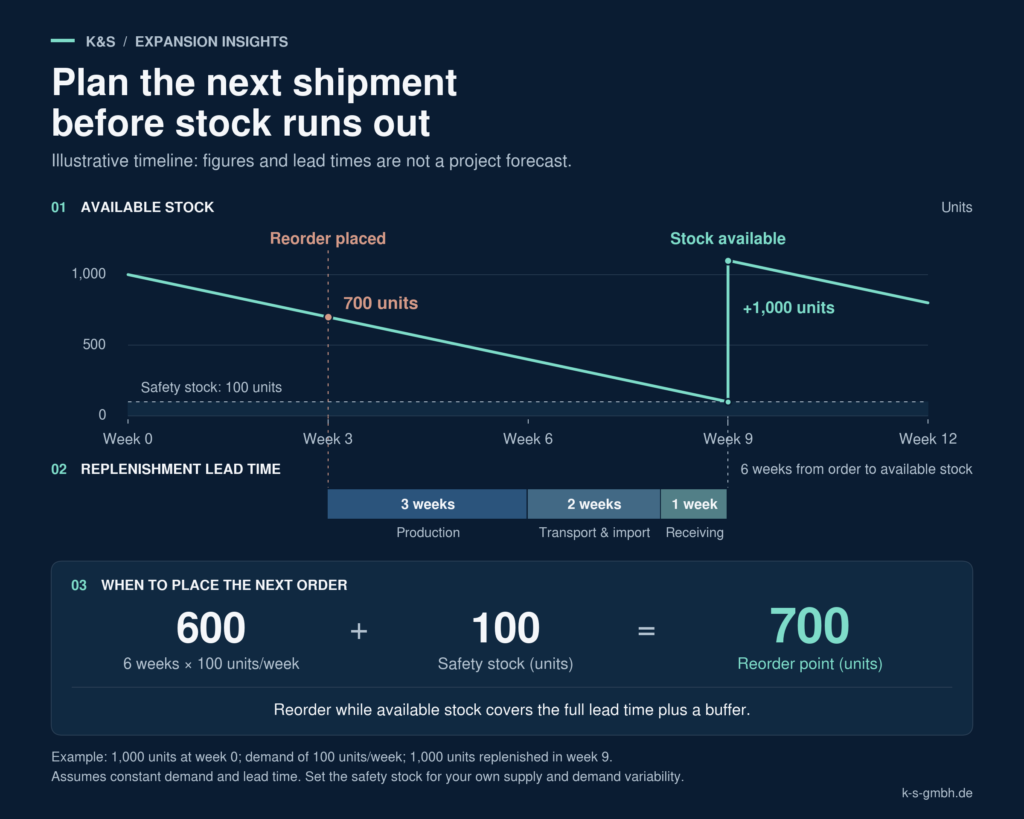
Map the full replenishment process, from placing an order to having stock available for customers. Include production, quality checks, transport, import processing and warehouse receiving. This total lead time determines how early you need to reorder. Strong initial sales can quickly become a problem if replacement stock cannot arrive before the first shipment sells out.
Stock allocation also needs planning. Decide how inventory will be divided between markets and how you will respond if demand exceeds expectations in one location. Separate visibility of sales and available stock helps prevent expansion from creating shortages at home. Where shelf life matters, allow enough time for transport, storage and sale when deciding shipment quantities.
Finally, identify the dependencies most likely to interrupt supply, such as a critical ingredient, a single supplier or an unreliable transport route. Depending on the constraint, suitable responses could include additional stock, alternative providers or a more gradual rollout.
Before launching, confirm that your supply plan covers the first shipment, subsequent replenishment and continued availability in your existing market. Where capacity or lead times remain uncertain, adjust the initial assortment, launch timing or marketing activity to match what you can reliably deliver.
06 – Are you prepared to adapt your product and positioning?
A successful home-market offering cannot be assumed to work unchanged in another country. Even a strong product may need adjustments before it can compete effectively. Customers may use it differently, compare it with different alternatives or value different benefits.
Some adaptations are driven by regulation. Packaging, labelling, ingredients, claims or product documentation may need to meet different local requirements. Identify these requirements early and arrange appropriate specialist checks before committing to production or finalising packaging. A claim used at home may need different wording, supporting evidence or regulatory review elsewhere.
Other adaptations are commercial. Customers may prefer different sizes, flavours, bundles or price points. A smaller pack, for example, could make an unfamiliar brand easier to try, while changing the economics of packaging and fulfilment. Each proposed adjustment should address a specific customer need and be reflected in the financial plan.
Localisation therefore extends well beyond translation. Product pages, imagery, messaging and positioning should reflect how local customers evaluate and compare products. Review which benefits matter most, how your offer differs from local alternatives and what evidence buyers need to trust it. Customer interviews, competitor reviews and feedback on proposed messaging can help test these assumptions.
This can require difficult decisions. Your best-selling product at home may not be the strongest choice for entering another market. A packaging format that supports attractive margins domestically may create excessive fulfilment costs abroad. Selecting a narrower initial range or adapting a format may give the brand a more viable starting point.
Define which elements are fundamental to the brand and where you are willing to adapt. Quality standards, sourcing commitments and a core product promise may be essential to its identity. Pack sizes, imagery and the emphasis placed on particular benefits may offer more flexibility. Brand consistency depends on preserving that recognisable core while making the offer relevant to local customers.
Before moving forward, establish which adaptations are necessary, what evidence supports them and what they mean for costs, production and timing. If the required changes undermine the brand’s core commitments or make the economics unattractive, reconsider the product selection or target market.
07 – Who will own the launch and the ongoing operation?
The expansion needs a clearly identified lead who coordinates the work, tracks progress and brings decisions to the right people. That person needs sufficient time, access to information and authority to keep the project moving.
Start by assessing the capabilities and capacity required. Market preparation, channel setup, marketing, inventory planning and financial oversight involve different skills. Decide which responsibilities your existing team can realistically absorb, where additional hires may be needed and which tasks are better supported externally. Assigning expansion to an employee also means deciding how their existing workload will be handled.
The choice between an internal team, external partners or a combination should reflect the work involved. Pay particular attention to responsibilities that cross between teams. If one provider manages advertising and another handles logistics, someone must ensure that campaigns match stock availability and replenishment plans. Individual tasks can be performed well while the overall operation remains poorly coordinated.
Define decision rights early. Agree who can adjust campaigns, approve product content, change prices and commit expenditure within agreed limits. Where external partners are involved, appoint an internal contact who can provide product information, coordinate supply and obtain timely approvals. The brand’s management should remain involved in significant strategic and financial decisions.
Plan the ongoing operation alongside the launch. Once sales begin, someone must monitor performance, resolve customer and platform issues, coordinate replenishment and act on new information. Regular reviews should connect sales, margins, marketing results and inventory with specific decisions and assigned actions.
Before committing to launch, each essential activity should have an owner, sufficient capacity and a clear route for resolving problems. The team responsible for building the new business should also know who will operate and develop it after the initial setup is complete.
Conclusion: What should you do next?
Your answers should help you identify the next decision and the information needed to make it.
Where demand, competition or pricing remain uncertain, begin with a focused market assessment and financial model. You do not need to have resolved these questions before starting the assessment; answering them is its purpose.
Where the opportunity appears attractive but funding, supply or operational capacity remain constrained, establish how those gaps will be addressed before committing to launch. If the evidence does not support a viable business case, adjust the approach, consider another market or postpone the investment.
The objective should therefore not be to find reasons to expand. It should be to determine whether the opportunity is strong enough to justify the investment and what would need to be true for the expansion to succeed.
Turn each remaining uncertainty into a concrete task: what needs to be established, who will investigate it and which findings would change your decision.
At K&S, we help established brands assess these questions and translate viable opportunities into operating businesses. Our work can begin with a standalone market assessment or financial model and continue through preparation, launch and ongoing growth.
Considering international expansion?
Complete our short questionnaire to tell us about your brand, target market and expansion plans. We will review your starting point and contact you to discuss whether our approach fits your needs and what a suitable next step could involve.